Curators: Marie-Eve Beaupré and Yun Wang
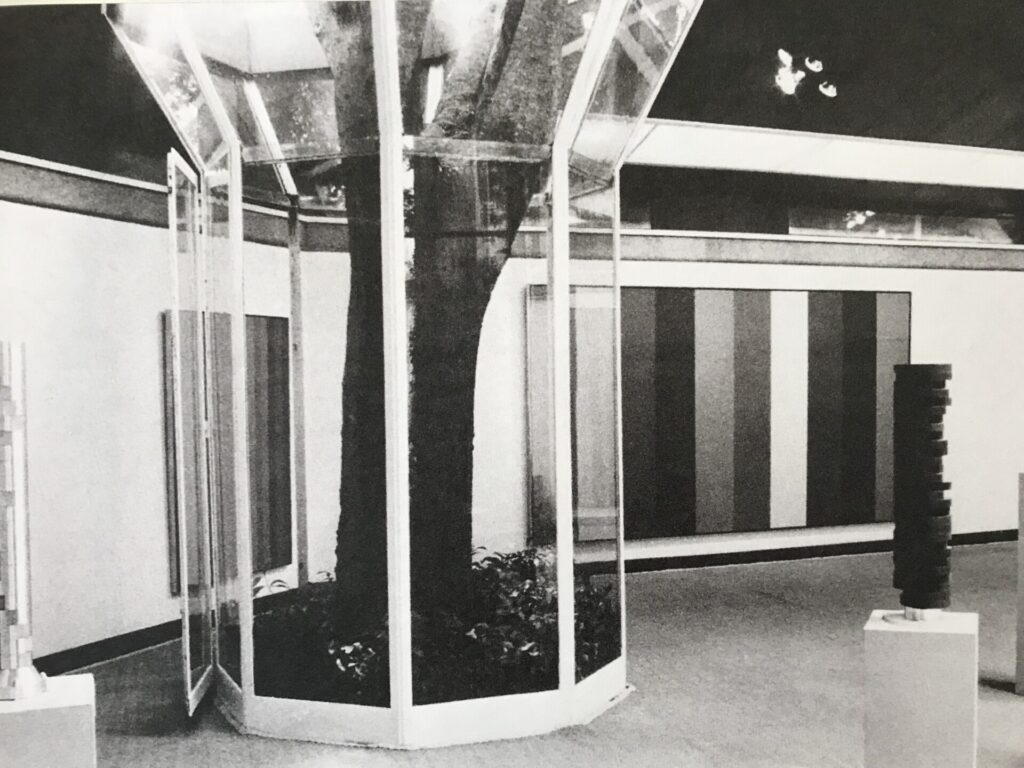
At the core of this project lies an in-depth re-reading of the exhibition by Ulysse Comtois and Guido Molinari at the Canadian Pavilion of the Venice Biennale in 1968—a pivotal moment in cultural and political history that must be understood as a major artistic event, revealing a social and institutional context undergoing profound transformation. The 1968 edition of the Biennale was indeed marked by widespread social protest movements, whose immediate impact was felt both in the reception of the Biennale as an institution and in the perception of the exhibited works, as well as in the positioning of the participating artists.
Artist Klaus Scherübel proposes to revisit this complex ensemble through an immersive installation developed from research in art history, museology, and social history. Working within a plastic and conceptual language that is distinctly his own—singularly combining image, text, publication, sculpture, architecture, and exhibition design—the artist creates a work that goes beyond mere reconstruction to interrogate the mechanisms of transmission, interpretation, and staging of the past within the contemporary museum space. As in his previous projects, the artist engages in a process of media and spatial transposition of historical documents. His approach involves shifting the conventional frameworks of museography in order to generate forms of experience and understanding that are sensorial, critical, and unexpected.
The project on the 1968 Biennale thus presents itself as an experimental form, a model of thinking in action, aimed at eliciting an aesthetic and cognitive experience from reconfigured documentary material. By employing innovative modes of reconstruction, Klaus Scherübel seeks to activate renewed public attention to the relationships between art, politics, and institutions—then as now.
Distribution partner: Fondazione La Biennale di Venezia